
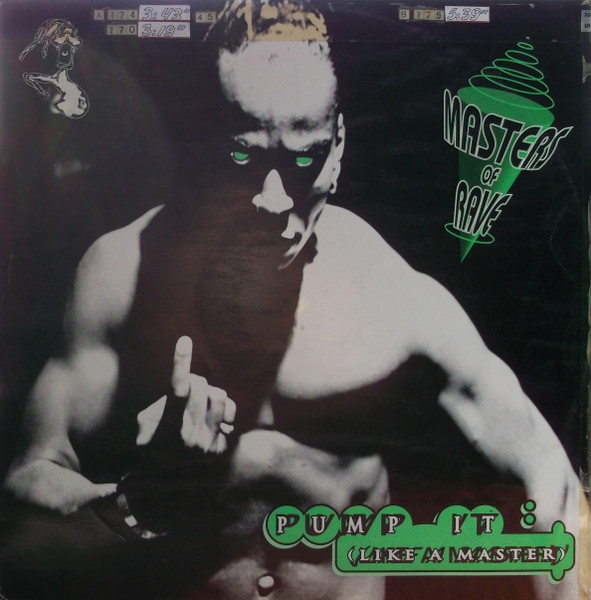
Pump It (Like A Master)
1995 · Vinyl
Multinational record label established in 1913, acquired by the Universal Music Group in December 1998 as part of the acquisition of the Polygram group, effective January 1999. Label Code: LC 0309 / LC 00309. [b]Please note:[/b] PolyGram seven-numeral catalogue numbers were introduced in April, 1970 - any previous release with such a number is a reissue from after that date. This catalogue numbering system was replaced with a new system initiated in August 1982 and tied to the barcode/EAN. It had six digits followed by a single number suffix denoting the format, usually xxxxxx-x. In the US, when it was introduced in February 1983, this was often prefixed by a three-digit code denoting a company division, i.e. xxx xxxxxx-x, and sometimes a further one-letter suffix (for example 422 822104-1Y). These new numbers were not seen outside Japan until early 1983 when compact discs were first released to the public outside that country. Rim text on labels of German LPs "Urheber- Und ..." was replaced by "Alle Urheber- Und ..." late 1976 / early 1977. Words such as Deluxe, Super, Special and Select are not part of the catalogue number - these are price codes and can be entered as identifiers. German Polydor post-war price codes for formats and series numbers (1950s and 1960s): EPH: 45 rpm, 17 cm, EP, Mono, 20 000 and 21 000 NH: 45 rpm, 17 cm, Mono, 22 000 to 24 000 and 66 000 KN: 45 rpm, 17 cm, Mono, 55 000 SEPH: 45 rpm, 17 cm, EP, Stereo, 224 000 SNH: 45 rpm, 17 cm, Stereo, 220 000 SKN: 45 rpm, 17 cm, Stereo, 223 000 LPH: 33 rpm, 25 cm, Mono, 45 000 LPHM: 33 rpm, 30 cm, Mono, 46 000 HPM: 33 rpm, 30 cm, Mono, 47 000 SLPH: 33 rpm, 25 cm, Stereo, 235 000 SLPHM: 33 rpm, 30 cm, Stereo, 237 000 For all unofficial releases (bootlegs, counterfeits, pirate compilations, etc.) that pretend to be Polydor releases, please use [L=Polydor (2)]. [b]Timeline[/b] 2 April 1913: Establishment of Polydor as a brand by German Polyphonwerke A.-G., based in Leipzig. 25 July 1914: The brand is registered as a trademark by the Imperial Patent Office Berlin (No. 316613). 1924: Polydor is established as an export label for Polyphon Record products to be marketed outside of Germany. 1927: Establishment of Société Phonographique Française Polydor S.A. in Paris, France, by the Danish and Swedish subsidiaries of Polyphonwerke A.-G. 1932: Polyphonwerke A.-G. takes over the liquidated Deutsche Grammophon-Aktiengesellschaft and continues under this name. 1941: After the takeover of Deutsche Grammophon by Siemens & Halske, the shellacs temporarily also appear under the label Siemens Polydor. 1946: Post-war production resumes and Polydor becomes the popular music arm. Classical music is separated to Deutsche Grammophon. 1949: Introduction of the red logo with golden stars and golden Polydor. 1953: Introduction of the orange logo with golden stars and Polydor within a white background. 1954: Establishment of Polydor Records Ltd. in the UK. 1963: Introduction of the red logo with half-black disc and white Polydor, still in use today with slight alterations. 1969: Polydor enters the US market. 1972: Philips and Deutsche Grammophon form PolyGram and Polydor becomes part of Polydor International. 1991: Polydor becomes part of the PolyGram Label Group. 1998: Seagram acquires PolyGram and merges it into Universal Music Group, effective January 1999. 2003: The German division is merged with Island Records Germany to Polydor Island Group. 2005: The Polydor Island Group is merged into Universal Music Domestic Division.
1995 · Vinyl
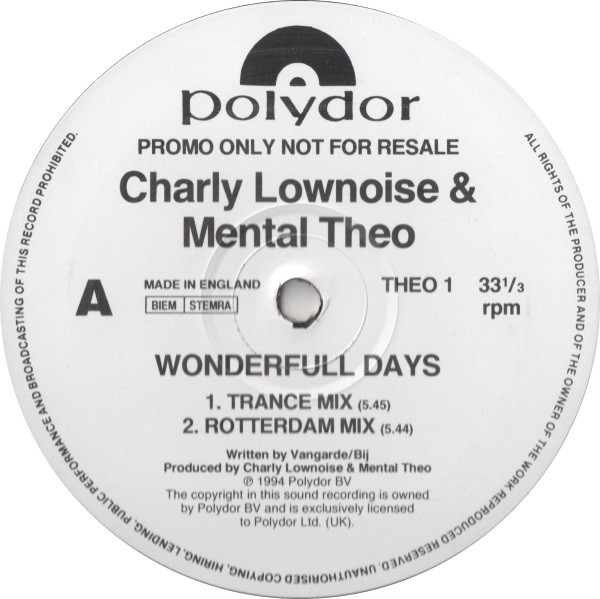
1994 · Vinyl
No tracked contribution history yet. Use this entry point to suggest a change, correction, or extra detail for the archive.
Community notes
Logged-in users can add label history, catalog corrections, and extra context for this imprint.
Log in to add a comment or reply.